
Outsourcing facilities management (FM) is transforming how businesses manage their physical spaces. No longer a simple cost-cutting measure, it’s now recognized as a strategic approach to enhance operational efficiency, improve service quality, and mitigate risk. This comprehensive guide explores the multifaceted world of outsourced FM, from initial selection and contract negotiation to leveraging technology for optimal performance. We will delve into the benefits, challenges, and best practices for successfully outsourcing your facility management needs, ultimately demonstrating how a strategic partnership can contribute to overall business success.
This guide examines the core components of effective outsourced FM, including a detailed comparison of in-house versus outsourced approaches. We will analyze the various services encompassed by typical contracts, highlighting cost savings, improved efficiency, and risk mitigation strategies. Furthermore, we will address the crucial aspects of selecting a reputable provider, negotiating favorable contracts, and leveraging technology to maximize the effectiveness of your outsourced FM solution.
Ultimately, our aim is to provide a clear and actionable framework for organizations seeking to optimize their facilities management through strategic outsourcing.
Choosing an Outsourcing Facilities Management Provider
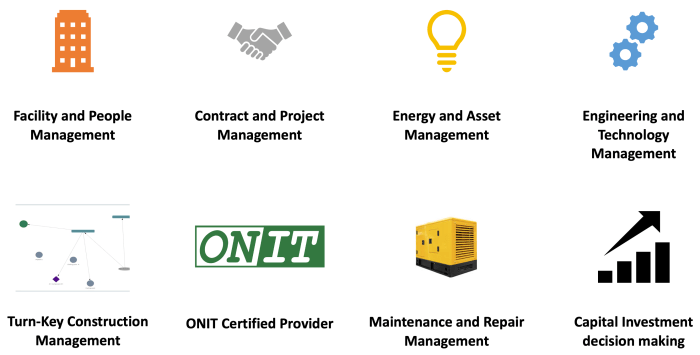
Selecting the right facilities management (FM) provider is crucial for ensuring smooth operations and cost-effectiveness. A poorly chosen provider can lead to disruptions, increased expenses, and ultimately, damage to your organization’s reputation. Therefore, a thorough and well-structured selection process is paramount.
Criteria for Selecting a Reputable FM Provider
Choosing a reputable FM provider requires careful consideration of several key criteria. These criteria should be weighed against your specific needs and organizational priorities. A strong provider will demonstrate a proven track record, financial stability, and a commitment to delivering high-quality services. They should also possess the necessary technological capabilities and a skilled workforce. Beyond these fundamental aspects, consider their experience in your specific industry, their understanding of your organizational culture, and their approach to sustainability and risk management.
A thorough assessment of these factors will significantly reduce the risk of selecting an unsuitable provider.
Evaluating Bids and Proposals
Once you’ve identified potential providers, the next step involves a rigorous evaluation of their bids and proposals. This process typically involves a standardized scoring system that weighs different criteria based on their relative importance to your organization. For example, you might assign higher weights to factors like experience in similar projects, financial stability, and the proposed service level agreements (SLAs).
The scoring system should be transparent and clearly communicated to all bidders to ensure fairness and consistency. The evaluation team should include representatives from different departments to ensure a holistic assessment. A detailed comparison matrix can help organize and analyze the different proposals effectively, allowing for a data-driven decision.
Checklist for Assessing Provider Qualifications and Experience
A comprehensive checklist is essential for streamlining the assessment process and ensuring that no critical aspects are overlooked. This checklist should cover areas such as:
- Company Profile and Financial Stability: Years in operation, financial statements, insurance coverage, client references.
- Experience and Expertise: Relevant industry experience, project portfolio, case studies demonstrating successful project delivery, client testimonials.
- Technical Capabilities: Technology used for service delivery, reporting, and communication; use of CMMS (Computerized Maintenance Management System) or similar software.
- Personnel and Training: Number of employees, qualifications of key personnel, training programs, safety records.
- Service Level Agreements (SLAs): Clearly defined service levels, response times, reporting mechanisms, and escalation procedures.
- Quality Management System: ISO 9001 certification or similar quality management system implementation.
- Sustainability Practices: Commitment to environmental sustainability, energy efficiency initiatives, waste management practices.
Best Practices for Negotiating Contracts
Effective contract negotiation is crucial for ensuring a mutually beneficial partnership with your chosen FM provider. Begin by establishing clear objectives and desired outcomes. This includes outlining specific service requirements, key performance indicators (KPIs), and payment terms. It’s important to thoroughly review the contract terms and conditions, paying close attention to clauses related to liability, termination, and dispute resolution.
Don’t hesitate to seek legal counsel to review the contract before signing. Remember, a well-negotiated contract protects your interests while fostering a collaborative relationship with the provider. Negotiation should be a collaborative process aimed at achieving a win-win outcome.
Key Considerations for Contract Management
- Regular Performance Monitoring: Establish a system for tracking KPIs and service delivery against the agreed-upon SLAs.
- Open Communication: Maintain open and consistent communication with the provider to address any issues promptly.
- Regular Meetings: Schedule regular meetings to review performance, discuss challenges, and plan for future needs.
- Performance Reviews: Conduct periodic performance reviews to assess the provider’s overall performance and identify areas for improvement.
- Dispute Resolution Mechanisms: Clearly define procedures for resolving disputes or disagreements.
- Contract Renewal: Establish a process for reviewing and negotiating contract renewals.
Key Aspects of Facilities Management Contracts
A well-structured facilities management (FM) contract is crucial for a successful outsourcing partnership. It Artikels the responsibilities of both the client and the provider, ensuring clarity and minimizing potential disputes. This section details the essential components of a comprehensive FM contract, emphasizing the importance of clear service level agreements (SLAs) and effective performance monitoring.
Essential Components of a Comprehensive FM Contract
A comprehensive FM contract should include a detailed description of the services to be provided, including specific tasks, responsibilities, and performance expectations. It should clearly define the scope of work, geographical location covered, and the duration of the contract. Furthermore, payment terms, including invoicing procedures and payment schedules, must be explicitly stated. Finally, the contract should Artikel procedures for contract termination, renewal, and dispute resolution.
A clearly defined escalation process for handling issues is also essential. For example, a contract might specify that minor maintenance issues are handled by the FM provider directly, while major repairs require client approval before proceeding.
Service Level Agreements (SLAs)
Clearly defined SLAs are the cornerstone of a successful FM contract. They establish specific, measurable, achievable, relevant, and time-bound (SMART) targets for the outsourced provider. These targets should cover key aspects of FM services, such as response times to maintenance requests, equipment uptime, and the cleanliness of facilities. For instance, an SLA might stipulate a response time of one hour for emergency repairs or a 98% uptime for critical building systems.
The consequences of not meeting these targets, including potential penalties or service credits, should also be clearly defined within the SLA. The detailed metrics Artikeld in the SLA enable objective performance measurement and accountability.
Monitoring and Evaluating Provider Performance
Regular monitoring and evaluation are vital to ensure the outsourced provider consistently meets the agreed-upon SLAs. This involves tracking key performance indicators (KPIs) and conducting regular performance reviews. Methods for monitoring performance can include regular on-site inspections, data analysis from building management systems (BMS), client feedback surveys, and regular meetings with the provider. Performance evaluations should assess not only the provider’s adherence to the SLAs but also the overall quality of services provided.
This might involve analyzing trends in maintenance costs, identifying areas for improvement, and discussing potential adjustments to the contract as needed. A robust system for collecting and analyzing data is essential for effective performance monitoring.
Liability and Insurance Clauses
FM contracts should include clauses addressing liability and insurance. These clauses define the responsibilities of each party in case of accidents, injuries, or property damage. The provider should carry adequate liability insurance to cover potential claims arising from their activities. The contract should specify the minimum insurance coverage required and require the provider to provide proof of insurance.
For example, a clause might state that the FM provider is liable for any damages caused by their negligence during the performance of their duties. Another clause might require the provider to maintain workers’ compensation insurance for their employees. Clearly defined liability clauses protect both the client and the provider from potential financial losses.
Key Performance Indicators (KPIs) for FM Contracts
| KPI | Measurement Method | Target Value | Reporting Frequency |
|---|---|---|---|
| Response Time to Maintenance Requests | Tracking of request submission and completion times | 1 hour for emergencies, 24 hours for non-emergencies | Monthly |
| Equipment Uptime | Data from BMS and maintenance logs | 98% | Monthly |
| Facility Cleanliness | Regular inspections and client feedback surveys | 95% satisfaction rating | Quarterly |
| Cost per Square Foot | Total FM costs divided by total square footage | $X per square foot (pre-defined budget) | Annually |
Facilities Management
Effective facilities management (FM) is crucial for optimizing the performance and value of an organization’s physical assets. It encompasses a wide range of activities aimed at creating a safe, productive, and sustainable work environment. A well-managed facility contributes directly to the bottom line by reducing operational costs, improving employee satisfaction, and enhancing the overall brand image.
Core Principles of Effective Facilities Management
Effective facilities management operates on several core principles. These include a proactive, rather than reactive, approach to maintenance; a strong emphasis on data-driven decision-making, using performance indicators to track efficiency and identify areas for improvement; a commitment to continuous improvement, constantly seeking ways to optimize processes and reduce waste; and a focus on collaboration and communication among all stakeholders, including employees, contractors, and management.
A holistic approach, considering the interconnectedness of various FM aspects, is also vital.
Aspects of Facilities Management
Facilities management encompasses a broad spectrum of services. Maintenance, encompassing preventative, corrective, and predictive strategies, is paramount for ensuring the longevity and functionality of building systems and equipment. Security involves implementing measures to protect personnel, assets, and information from theft, damage, and unauthorized access, often including access control systems, surveillance technologies, and emergency response protocols. Sustainability is increasingly important, focusing on minimizing environmental impact through energy efficiency measures, waste reduction programs, and the use of eco-friendly materials and practices.
Other crucial aspects include space planning and management, ensuring efficient use of available space; health and safety, prioritizing employee well-being and compliance with regulations; and vendor management, overseeing the performance of external service providers.
Comparison of Facilities Management Approaches
Different organizations employ varying approaches to facilities management. Some opt for in-house management, employing dedicated staff to handle all aspects of FM. This offers greater control but can be more expensive and require significant internal expertise. Others choose outsourcing, contracting with external providers for all or part of their FM needs. This can be more cost-effective and provide access to specialized skills but may involve relinquishing some control.
A hybrid approach combines in-house management with outsourced services, allowing organizations to tailor their FM strategy to specific needs and resources. The optimal approach depends on factors such as the organization’s size, budget, and specific requirements.
Examples of Successful Facilities Management Strategies
Several organizations have implemented successful FM strategies that demonstrate the positive impact on business outcomes. For example, a large technology company implemented a comprehensive preventative maintenance program, reducing equipment downtime and extending the lifespan of its assets, resulting in significant cost savings. A healthcare provider successfully integrated sustainable practices into its FM strategy, reducing its energy consumption and improving its environmental footprint, while simultaneously enhancing its brand image and attracting environmentally conscious employees.
A multinational corporation streamlined its space management through improved utilization and technology implementation, leading to a reduction in real estate costs and increased employee productivity. These examples highlight the diverse ways in which effective FM strategies can drive business success.
Facilities Management’s Contribution to Overall Business Success
Facilities management plays a critical role in achieving overall business success. By optimizing the efficiency and functionality of physical assets, FM directly impacts operational costs, employee productivity, and brand image. Reduced downtime, improved energy efficiency, and enhanced safety contribute to cost savings. A comfortable and productive work environment improves employee satisfaction and retention, boosting morale and productivity.
A well-maintained and aesthetically pleasing facility enhances the organization’s brand image, attracting clients and partners. Ultimately, effective FM contributes to a stronger bottom line and a more sustainable and successful business.
Successfully outsourcing facilities management requires careful planning, diligent selection of a provider, and ongoing monitoring of performance. By understanding the benefits, challenges, and best practices Artikeld in this guide, organizations can confidently leverage outsourced FM to achieve significant improvements in operational efficiency, cost savings, and overall business performance. The strategic use of technology, robust contract management, and effective communication are all key factors in realizing the full potential of this approach.
A well-executed outsourced FM strategy positions your business for growth and success by freeing internal resources to focus on core competencies.
Expert Answers
What are the typical contract lengths for outsourced facilities management?
Contract lengths vary but commonly range from one to five years, depending on the services and the client’s needs.
How do I measure the success of my outsourced FM provider?
Use Key Performance Indicators (KPIs) defined in your contract, such as response times to maintenance requests, tenant satisfaction scores, and cost per square foot.
What happens if I’m unhappy with my outsourced FM provider’s performance?
Your contract should Artikel a clear process for addressing performance issues, including escalation procedures and potential remedies.
Can I outsource only specific FM services instead of the entire operation?
Yes, many providers offer a la carte services, allowing you to outsource specific tasks like cleaning, security, or maintenance, while retaining control of other areas.


